The Compliance Line Companies Shouldn’t Cross
Indonesia continues to attract global investors—especially From companies that expanding operations across manufacturing, services, and digital sectors.
But many stumble on one deceptively simple compliance area: statutory leave.
It feels flexible, but in Indonesia, leave is a hard legal right, not a soft benefit.
Failing to grant it properly can lead to:
- penalties,
- compensation claims,
- forced contract termination,
- or full-blown labor disputes.
This article refers to Indonesia’s Manpower Law (UU 13/2003), Maternal and Child Welfare Law (UU 4/2004),and Regulation on Employment Agreements (PP 35/2021) to outline statutory leave types, leave rules, employer obligations, and key compliance guidelines for companies in Indonesia.

01 — Overview of the Statutory Leave System
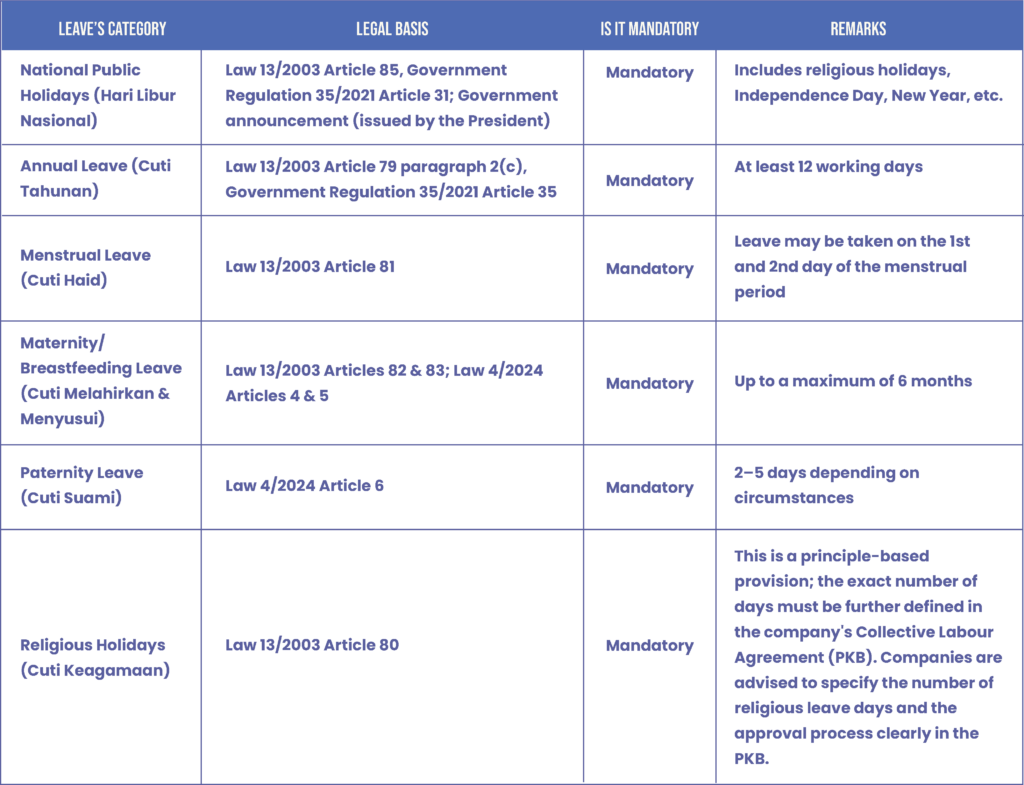
Indonesia’s statutory leave system consists of the following categories:

02 — Detailed Breakdown of Key Statutory Leave Types
1. National Public Holidays : Mandatory days off, no substitution or compensatory leave allowed
Each year, Indonesia’s President issues the national public holiday list (about 16–20 days), including major Islamic, Christian, Chinese, Buddhist, and national holidays.
Q: Is leave mandatory?
Yes. Companies must give the day off. No substitutions or make-up workdays are allowed.
Q: If employees must work?
Employers must:
- Get written consent;
- Pay overtime (2–4× daily wage under PP 35/2021 Art. 31);
- Provide substitute leave where applicable.
⚠️ Compliance Tip:
“Voluntary overtime” on public holidays without proper procedures is illegal and may lead to fines or forced shutdowns.
2. Annual Leave : Minimum 12 Days, Cannot Be “Zeroed Out” or Converted to Cash
Leave entitlement :
Employees who have worked continuously for 12 months are entitled to at least 12 working days of annual leave.
Q: Can annual leave be converted to cash?
No. Annual leave is a statutory right. Employers cannot force employees to forfeit leave or convert it into cash.
Q: Can annual leave be carried forward?
Yes, but the common practice is that it must be used within 6 months.
Q: Can companies implement “collective leave”?
Yes, but employees must be informed in advance, and the total annual leave entitlement cannot be less than 12 days.
⚠️ Compliance Tip:
Some companies apply a “use it or lose it” policy or restrict leave to low-season periods. If done without employee consent, this is considered non-compliant.
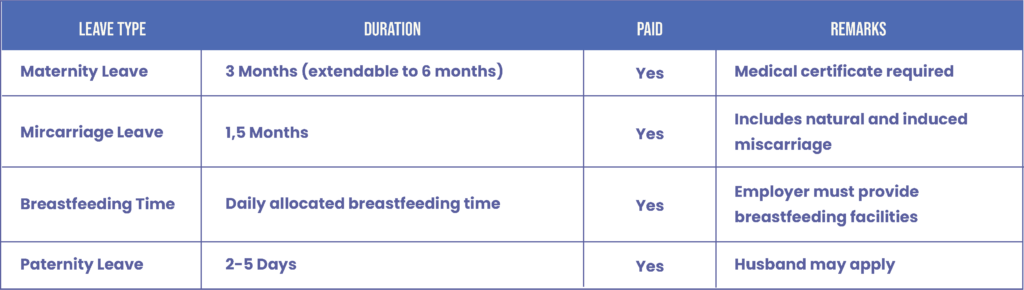
3. Maternity & Breastfeeding Leave : Employers Must Grant Full Entitlement Without Interference
According to the Maternal and Child Welfare Law (UU 4/2024), female employees are entitled to the following rights:
Q: Can the company refuse the leave?
No. Denying maternity leave is a serious violation and may result in fines, compensation orders, license suspension, or even criminal penalties.
Q: Can the company reassign or reduce salary?
No. Employees receive full pay during maternity leave and cannot be dismissed, demoted, or reassigned due to pregnancy or breastfeeding.
⚠️ Compliance Tip:
Asking employees to return early or work from home without their consent remains illegal.
4. Mentrual Leave : Up to 2 Days per Month, Cannot Be Dennied
-Eligible employees: All female employees
-Leave entitlement: The 1st and 2nd days of menstruation
Q: Must the company approve it?
Yes. Employers cannot request a medical certificate and cannot refuse the leave.
Q: Is it paid?
Yes. It is treated as a normal working day.
⚠️ Compliance Tip:
Some HR departments reject menstrual leave requests for lack of a medical certificate. This is illegal, and employees may file complaints with labor inspectors.
5. Long Leave (Extended Leave) : Not Mandatory, but Must Be Granted Once Promised
–Eligibility: Employees who have worked continuously for 6 years in the same company, or as defined in the company’s internal policy.
-Duration: 2 months (taken over two years, 1 month each year), or based on internal company rules.
Q: Is it paid?
Yes. It follows the same entitlements as annual leave, and employees receive paid leave.
Q: Can the company choose not to grant it?
If it is not stated in company regulations or collective agreements, the company may choose not to provide it; however, once it is promised in official policies, it becomes mandatory.

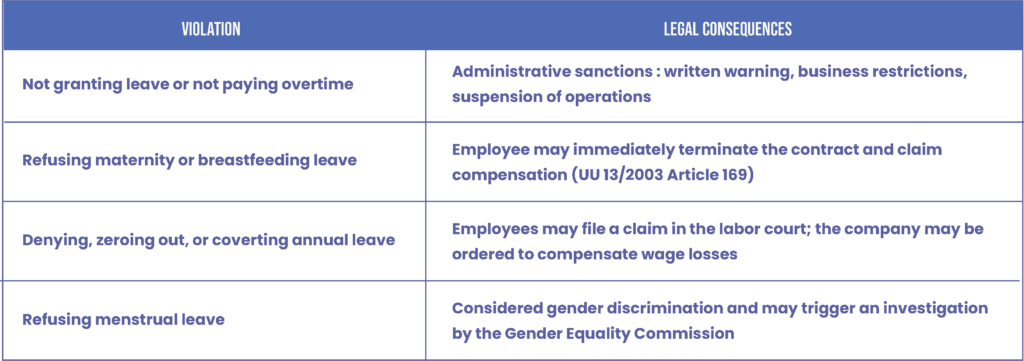
03 — What Happens If You Break the Rules?
According to Article 185 of the Manpower Law and Article 61 of PP 35/2021, companies that fail to provide statutory leave may face the following consequences:

04 — Practical Steps to Stay Compliant
✓ Build a clear leave policy in your Employee Handbook
✓ Plan annual leave early to avoid year-end crunch
✓ Use HR systems to trigger leave-eligibility reminders
✓ Never assume “no request = no leave”
✓ For holiday overtime, report to the labor office when required

05 — Conclusion: Leave Is a Right, Not a Perk
In Indonesia, leave entitlements are mandatory rights—not flexible benefits. For Foreign-invested companies, proper leave compliance is essential for legal safety and for maintaining healthy employee relations and reputation.
Legal Recommendation:
Make leave compliance part of your annual audit and seek regular reviews from labor law specialists to avoid costly violations.
For assistance with leave policies, handbook reviews, or labor inspections, our Indonesia labor law team is ready to help.
This article was prepared by our team serving clients in manufacturing, services, digital platforms, and EPC projects.